


News to Ewes – Vacation Time Ends: Ewes Meet the Rams

Donald G. Ely and Debra K. Aaron
University of Kentucky
Ewes typically work 7 to 9 months of the year (5 months gestation and 2 to 4 months lactation). The rest of the time is spent on vacation. To begin their vacation, their body condition and other external characteristics may indicate they should be checked for stomach worms. Use the FAMACHA system for this check. Deworm younger ewes that have a score of 3, 4, or 5. Those with a 3 are “on the bubble”. Older ewes with 4 or 5 scores should probably be culled. The beginning of the vacation period is a good time to trim feet and run ewes through a 10% zinc sulfate foot bath. Once milk production has ceased and udders have involuted, each needs to be palpated to identify any variations from soft, pliable, udders that are free from lumps. Cull those with abnormal udders.
The most important factor to consider when managing ewes on vacation is body condition; ewes should not become too fat. At lamb removal, healthy ewes should have a body condition score (BCS) of 1.5 to 2.0. They should retain this score until they come off vacation to begin the next nutritional flushing/breeding period. To accomplish this, shepherds must continually monitor internal parasite loads via FAMACHA, prevent foot problems, and continually supply them with a complete mineral and cool, fresh, clean water. Control pasture forage intake by adjusting stocking rates and rotationally grazing pastures.
In contrast to ewes, rams may only work 1 to 2 months of the year. Many consider rams the most important members of the flock because they contribute half the flock’s genetics. However, they are often the most neglected members of the flock.
Puberty
Ram lambs typically reach sexual maturity (puberty) between 6 and 8 months of age, but onset of puberty may be delayed by low planes of nutrition. More prolific breeds and hair breeds reach puberty earlier than other breeds and meat-type breeds reach puberty earlier than wool-type breeds.
Sperm Production
It usually takes 6 to 7 weeks for sperm cells to reach maturity in rams. Sperm cells are stored in the epididymis of the testicle, so palpation for a large, firm epididymis in a relatively large testicle is indicative of a large reservoir of sperm cells. Testicle size and sperm production are responsive to nutrition to the point that improving nutritional intake of rams during a 2-month period can double testicle size and sperm production. Testicle size, sperm production, and mating capacity of rams raised in temperate climates may vary in different seasons of the year, the highest during the fall and lowest in the spring. Rambouillet and Merino rams are the least seasonal in their breeding behavior, followed by the Polypay and Romanov. The most seasonal are meat-type breeds, like Hampshire, Suffolk, and Southdown.
Mating
Ewes in heat may seek out the rams. They sniff, chase, and follow rams around. Rams respond to urination of ewes by sniffing, extending their back legs, and curling their lips. If the females are receptive, they will stand for mating. Rams may mate with the same ewe more than once and may have a tendency to select older ewes over younger ones. In large flocks, multi-sire matings are usually necessary. If more than one ram is used per flock, the shepherd should recognize that older rams usually dominate younger ones and may prevent them from breeding. Rams may fight. Also, it will be hard to identify infertile rams. Although these problems can be avoided in single-sire matings, these matings may result in low conception rates, especially if rams with reduced fertility or libido (sex drive) are used. Some breeds show libido continuously after they reach puberty, while others show it during the nonbreeding season (spring). Rams that are too thin or too fat lack libido. Age and lameness will also reduce libido and some rams have inherently low libido. The best way for producers to evaluate mating behavior is probably by observing breeding performance when rams are exposed to ewes. Use of raddle marks can indicate breeding activity. Color of the paint or marking crayon should be changed every 16 to 17 days. If rams fail to mark ewes, they may lack libido. If a high percentage of ewes re-mark after the first 16 to 17 days, this indicates mating occurred, but ewes didn’t conceive because the rams were sterile.
Breeding Soundness Exam
Preparing rams for a breeding season should begin at least 2 to 4 months before the season is to begin. Rams should be fed a balanced diet that will keep them from getting too fat or too thin. Keep them as cool as possible, in shaded areas or open-sided barns, and make sure they don’t get hurt fighting with other rams. Then, conduct a breeding soundness exam (BSE) to evaluate potential ability of rams to impregnate a given number of ewes within a defined breeding (mating) period. Examine eyes, legs, gait, teeth, body temperature, and body condition. Depression, pink eye, foot rot, lameness, sore mouth, ring worm, or presence of other contagious diseases can render rams either unuseable or questionable for breeding. A BCS of 1 to 2 is questionable as is a 5. A BCS of 3 or 4 is satisfactory. Examine the prepuce, penis, and scrotal contents. Cryptorchidism, hernias, epididymitis, scrotal abscesses, and pizzle rot also render rams unsatisfactory for breeding.
Consistency of the testicles and epididymis during the normal breeding season (fall), without any exposure to ewes, should be firm and spongy. If not, the rams are probably not useable. However, flaccid (soft and flabby) testicles are normal in the off-breeding season (spring) or if rams have been with ewes only for a week or so. Rams with any lesions, lumps, hard or soft spots, swellings, atrophy, or any differences in size of testicles should not be used. Scrotal circumference (width of the testicles at their widest point) should be determined because this measurement is an indicator of rams’ breeding abilities. Sperm production is greatest in rams with the largest circumference, although it may vary with season of the year. The largest circumference and greatest sperm production occurs during the fall of the year. Table 1 shows the accepted scrotal circumference measurements for rams.

If rams are satisfactory or exceptional, the rest of the BSE may be unnecessary. If questionable, continue with the next step of the BSE, which is semen evaluation. Semen samples are usually collected by a veterinarian and evaluated under a microscope for sperm mobility, morphology, and presence of white blood cells. Abnormal mobility and morphology indicate infertility and presence of white blood cells indicates an infection, such as epididymitis.
Ram Management
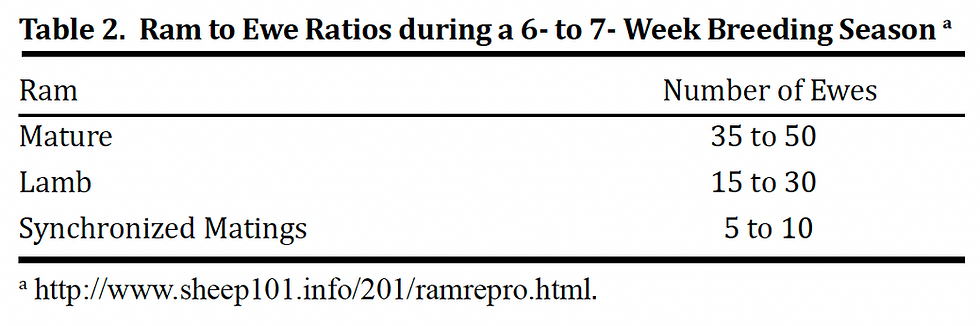
Shear, treat for internal parasites (if necessary), and trim rams’ feet 2 to 4 weeks before the breeding season begins. Also, feed the breeding season diet, especially the concentrate portion, for a month before the season begins to ensure the ram’s BCS is at least 3 to 4 when the breeding season begins. The number of ewes a ram can successfully cover during a 6- to 7- week breeding season is shown in Table 2. The ram lambs in Table 2 should be 7 to 8 months old and should weigh at least 50 to 60% of their expected mature weights.
Teaser Rams
Teaser rams have been vasectomized. They can ejaculate seminal fluids, but no viable sperm cells. They secrete testosterone like “intact” rams. Introduce them to ewes 14 days before the breeding season is to begin. They are used to produce the “ram effect”, which stimulates anestrus (noncycling) ewes to ovulate by their introduction into a group of ewes. Rams (and teasers) produce pheromones, the smell of which can stimulate the onset of estrus (heat) outside the normal fall breeding season. This effect can also synchronize estrus. For this to be most effective, ewes and rams need to be separated by at least 0.25 mile for a month before introduction of teasers and subsequent fertile rams.
Teasers appear to stimulate ewes to ovulate 3 to 4 days after introduction. This first ovulation will be in a “silent” heat, which cannot be detected by either teasers or fertile rams. Two normal estrus peaks follow the silent heat. Replacing teasers with fertile rams on day 14 will allow fertile rams to catch some ewes cycling around day 18 (4 days after introduction). The rest of the ewes should cycle around day 25 (11 days after the introduction of fertile rams). Ewes that do not conceive at either of these times may return to estrus (heat) 16 to 17 days later. Theoretically, 60 to 70% of the ewes will conceive at the first estrus. Sixty to seventy percent of the remaining ewes should conceive on the second estrus. Five to 10% of the ewes may conceive later in the breeding season or may not conceive at all, depending on the time of the year. Overall, the use of teasers can be an economically efficient way to synchronize estrus and, thus, the lambing season. Use of teasers instead of fertile rams for the first 14 days tends to synchronize estrus and, thus, the lambing season.
The “ram effect” is not as successful with ewe lambs. It is most sucessful during the transition period when ewes have not begun to cycle, but are almost ready. This would apply to “seasonal breeders” with a breeding season from August to October and a lambing season in January and February. The “ram effect” may not apply to ewes bred during November and December to produce April lambs because all breeds of ewes should be cycling during this period. The breeding season is shorter in this scenario so ewes tend to synchronize themselves. On the contrary, “seasonal breeders” to be bred “out-of-season” (in April or May) sometimes respond to teasers. Granted, these ewes are far away from their normal breeding season, but as many as 30% may respond to the “ram effect”. Still, this response may vary from year to year because of uncontrollable environmental differences from one year to another.
Summary
Sheep producers expect ewes coming off vacation to conceive early in the breeding season so the subsequent lambing season will be short. Even though ewes may be ready, rams may ultimately be responsible for a successful breeding season. Introducing teasers to a group of anestrus ewes for 14 days may stimulate silent heats, but no pregnancies. The “ram effect” occurs when fertile rams replace teasers. Rams that successfully passed a BSE, have a BCS of 3 to 4, and have been separated some distance from ewes for at least one month can produce synchronized conception rates. This effect is most pronounced with ewes that are not cycling but are almost ready (August/September breeding). Thirty percent of seasonal breeders bred out-of-season may respond to this “ram effect” although this is still dependent on uncontrollable, yearly environmental conditions.
Reference: http://www.sheep101.info/201/ramrepro.html
Dr. Donald G. Ely, professor in the Department of Animal & Food Sciences at the University of Kentucky
Dr. Debra K. Aaron, PhD, professor in the UK Dept. of Animal Sciences, teaches animal science and genetics. Her research interests are in sheep breeding genetics.


Comments